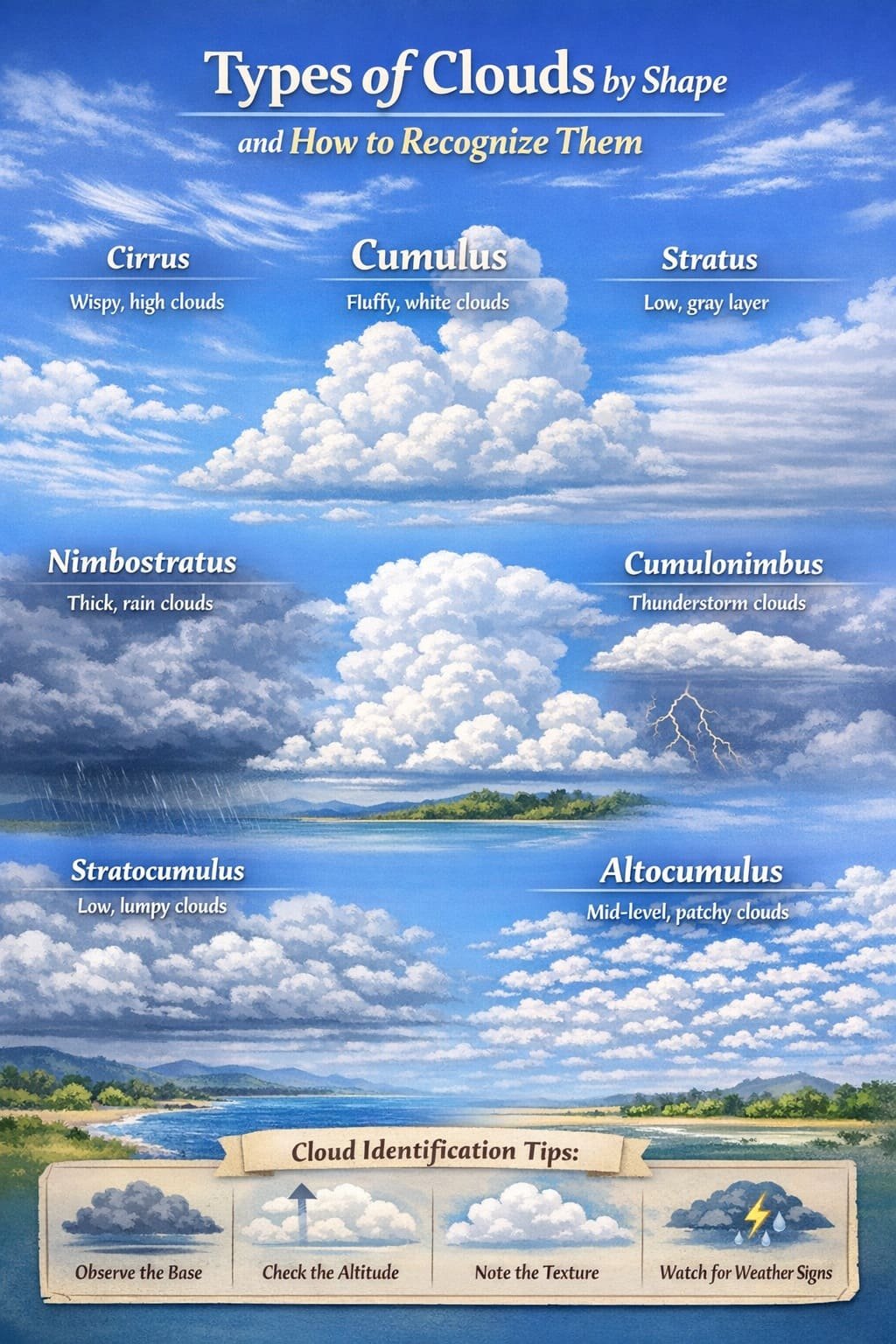
Types of Clouds by Shape: A Simple Guide to Identifing Clouds in the Sky

Discover the different types of clouds by shape and learn how to recognize them in the sky. This simple guide helps you identify cloud patterns and understand upcoming weather changes.

Learn
18. Feb 2026
57 views
Types of Clouds by Shape: A Simple Guide to Identifing Clouds in the Sky


Clouds are fascinating atmospheric phenomena that not only create beautiful skies but also provide vital clues about the weather. Meteorologists and weather enthusiasts often classify clouds based on their shape, which helps in predicting upcoming weather conditions. Understanding the different types of clouds and recognizing them in the sky can be both educational and practical.

Types of Clouds

1. Cirrus Clouds

Appearance: Cirrus clouds are thin, wispy clouds that appear high in the sky, often above 20,000 feet. They look like delicate streaks of white against the blue sky.

How to Recognize:

  • Wispy or hair-like formations.
  • High altitude, often moving quickly.
  • They rarely bring precipitation but indicate a change in weather, such as an approaching warm front.

2. Cumulus Clouds

Appearance: Cumulus clouds are fluffy, white, and have a cotton-like appearance. They typically form at lower altitudes.

How to Recognize:

  • Rounded, puffy tops with flat bases.
  • Usually bright white but can turn gray when dense.
  • Common on sunny days, indicating fair weather, though they can develop into cumulonimbus clouds leading to storms.

3. Stratus Clouds

Appearance: Stratus clouds form in uniform gray layers covering most of the sky. They are low-altitude clouds and often create an overcast appearance.

How to Recognize:

  • Gray, featureless sheet covering the sky.
  • Produce light drizzle or mist but not heavy rain.
  • Lack distinct shape and give the sky a gloomy look.

4. Nimbostratus Clouds

Appearance: These are thick, dark clouds that cover the sky entirely and bring continuous rain or snow.

How to Recognize:

  • Gray to dark gray color.
  • Dense and featureless, stretching across the horizon.
  • Associated with steady precipitation rather than thunderstorms.

5. Cumulonimbus Clouds

Appearance: These towering clouds are associated with thunderstorms and severe weather. They can extend from low altitudes to the top of the troposphere.

How to Recognize:

  • Large, dense, and towering structure.
  • Flat, anvil-shaped top caused by high-altitude winds.
  • Often accompanied by lightning, heavy rain, and strong winds.

6. Stratocumulus Clouds

Appearance: Stratocumulus clouds are low-lying clouds that appear in patches or rolls, often with breaks of clear sky in between.

How to Recognize:

  • Lumpy or rolling layers.
  • Grayish or white with darker shading.
  • Usually indicate stable weather, though light rain or drizzle is possible.

7. Altocumulus Clouds

Appearance: Altocumulus clouds are mid-level clouds that appear as white or gray patches, often forming patterns like fish scales or waves.

How to Recognize:

  • Small, fluffy clouds grouped together.
  • Mid-altitude, usually between 6,500–20,000 feet.
  • Presence in the morning may indicate thunderstorms later in the day.

Tips for Recognizing Clouds by Shape

  1. Observe the Base: Low clouds usually have a flat base, while high clouds appear wispy or fibrous.
  2. Check the Size and Texture: Fluffy, puffy clouds are often cumulus, while smooth sheets indicate stratus.
  3. Consider the Altitude: High, thin clouds are cirrus; mid-level clouds are altocumulus or altostratus; low clouds are stratus or stratocumulus.
  4. Look for Weather Signs: Dark, dense clouds often mean rain, while white and scattered clouds usually indicate fair weather.

Final Thoughts

Recognizing clouds by their shape is a practical skill for weather prediction and appreciating nature’s beauty. From the wispy cirrus to the towering cumulonimbus, each cloud type tells a story about the atmosphere. Next time you step outside, take a moment to observe the sky—it’s like reading nature’s own weather forecast.

FAQs

Q1. How many types of clouds are there by shape?

There are several, but the most common include cirrus, cumulus, stratus, nimbostratus, cumulonimbus, stratocumulus, and altocumulus.

Q2. Which clouds indicate good weather?

Cumulus clouds usually signal fair weather when they are white and fluffy with clear skies around them.

Q3. What clouds bring heavy rain or storms?

Cumulonimbus clouds are associated with thunderstorms, heavy rain, lightning, and strong winds.

Q4. How can I identify clouds quickly?

Look at their shape, altitude, color, and thickness. Puffy clouds are cumulus, thin wisps are cirrus, and gray layers are stratus.

Q5. Why is learning cloud types useful?

Recognizing clouds helps you predict weather changes and better understand atmospheric conditions.

Image Credits: Created by ChatGPT using DALL·E (OpenAI).

The information in this article is for general reference only. Product details, pricing, and availability may change over time, and we can’t guarantee everything is 100% accurate. Some content may be created with the help of AI tools like ChatGPT. Please check the official website or seller before making a purchase. Some articles may contain affiliate links, and we may earn a small commission at no extra cost to you.

To know more about our platform, visit our About Us page.


Image Disclaimer: Product images are used for reference and review purposes only. All trademarks, logos, and images belong to their respective brands or Amazon sellers.

Follow on LinkedIn

Comments

No comments has been added on this post

Add new comment

You must be logged in to add new comment. Log in
Saurabh
Learn anything
PHP, HTML, CSS, Data Science, Python, AI
Categories
Review
Check all Products Review.
Gaming Blog
Game Reviews, Information and More.
Learn
Learn Anything
Factory Reset
How to Hard or Factory Reset?
Osclass Solution
Find Best answer here for your Osclass website.
Information
Check full Information about Electronic Items. Latest Mobile launch Date. Latest Laptop Processor, Laptop Driver, Fridge, Top Brand Television.
Pets Blog
Check Details About All Pets like Dog, Cat, Fish, Rabbits and More. Pet Care Solution, Pet life Spam Information
Lately commented
This is a great resource for dog lovers looking for inspiring and humoro... ·
Top 50 Dog Quotes for Social Media: ...
This is a helpful resource for pet owners who are concerned about their ... ·
Why my dogs eat grass? When To Be Wo...
Thank you for creating this valuable resource on plant toxicity in dogs.... ·
What Plants Are Toxic to Dogs: A Com...
This article offers valuable insights into potential causes and treatmen... ·
What to Do if Your Dog Is Rubbing It...
Thank you for creating this comprehensive guide. It's very helpful! ·
50 Essential Digital Marketing FAQs ...
Great job! This is really well done. ·
Top 10 Data Analytics Courses Instit...
Thanks for the tips on choosing the best earbuds for workouts. ·
How to Choose the Best Wireless Earb...
Excellent post. I am facing a few of these issues as well.. ·
Non-Health Reasons Your Cat Has Stop...