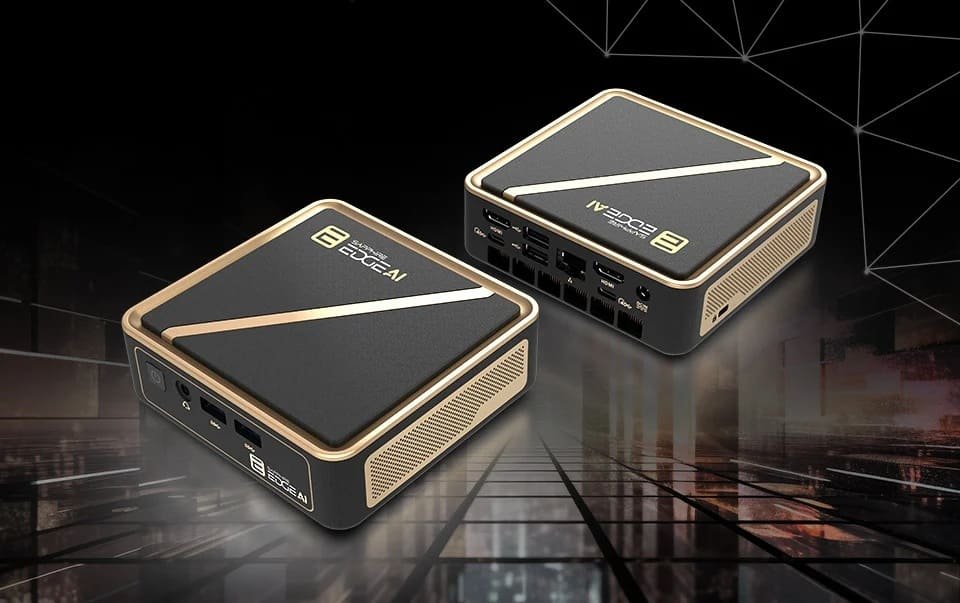
Sapphire, a name long associated with high-performance graphics cards, has officially entered the mini PC segment with the launch of its Edge AI series. Designed to harness the power of AMD’s latest Ryzen AI 300 series processors, these new mini PCs deliver a compelling mix of compact design, AI computing capability, and robust performance for productivity, creative workloads, and edge computing applications.
The Sapphire Edge AI mini PC series marks the company’s first step into the rapidly growing small form factor computing market. Tailored for AI-driven tasks and energy-efficient performance, the Edge AI lineup offers high-end specifications in a sleek, portable enclosure. The series includes three distinct models—Edge AI 370, Edge AI 350, and Edge AI 340—each featuring AMD’s cutting-edge Ryzen AI chipsets and integrated Radeon graphics for optimized machine learning and AI acceleration.
Sapphire’s new Edge AI mini PCs are powered by AMD’s Ryzen AI 300 processors, which integrate next-generation NPUs for advanced AI workloads. Each variant in the series brings its own level of performance to meet different user needs:
Edge AI 370 – Equipped with the flagship Ryzen AI 9 HX 370, featuring 12 cores and 24 threads, along with a powerful Radeon 890M GPU.
Edge AI 350 – Powered by the Ryzen AI 7 350, offering 8 cores and Radeon 860M graphics for balanced performance.
Edge AI 340 – Runs on the Ryzen AI 5 340, with 6 cores and Radeon 840M graphics, delivering reliable efficiency for everyday workloads.
All three processors support up to 50 TOPS (Trillions of Operations Per Second) of AI compute performance, making them suitable for demanding inference, vision processing, and data analysis applications.
Each mini PC supports up to 96GB of DDR5 SO-DIMM memory across dual channels, ensuring smooth multitasking and fast response times. For storage, users can configure multiple M.2 PCIe SSDs, providing both speed and flexibility for various deployment scenarios.
Sapphire’s design philosophy with the Edge AI series emphasizes both functionality and elegance. The mini PCs feature a compact 117 x 111 x 30 mm chassis with a black-and-gold finish, giving them a modern and premium appearance. A magnetic top cover allows users to access the internal components easily—no tools required—making upgrades and maintenance straightforward.
To ensure efficient thermal management, ventilation slots are strategically positioned at the bottom and sides of the chassis. This design helps maintain stable performance under heavy workloads while minimizing noise levels.
Despite its small footprint, the Edge AI series offers an impressive range of connectivity options.
Front I/O includes:
Rear I/O includes:
Additionally, the systems include a pre-installed M.2 WLAN module for Wi-Fi and Bluetooth connectivity, ensuring modern wireless performance out of the box.
The Edge AI mini PCs are compatible with both Windows and Linux, catering to diverse user needs—from developers and creators to enterprise deployments. Each model also supports VESA mounting, allowing it to be discreetly installed behind monitors or integrated into tight workspaces, making it ideal for commercial and industrial use cases.
As of now, Sapphire has not revealed official pricing or release dates for the Edge AI lineup. However, given the company’s strong track record in PC hardware and AMD partnerships, the Edge AI mini PCs are expected to compete strongly in the premium compact PC segment once launched.
Sapphire’s entry into the mini PC market with the Edge AI series is a promising move that blends AI capability, AMD innovation, and modern design into a portable form factor. With support for Ryzen AI 300 chips, up to 96GB RAM, USB4, HDMI 2.1, and tool-free upgrades, these devices are poised to appeal to professionals seeking AI-ready performance in a compact chassis.
While pricing and availability details remain under wraps, the Edge AI series could redefine expectations for what small PCs can achieve—especially in AI computing, edge processing, and content creation.
To know more about our platform, visit our About Us page.


Comments