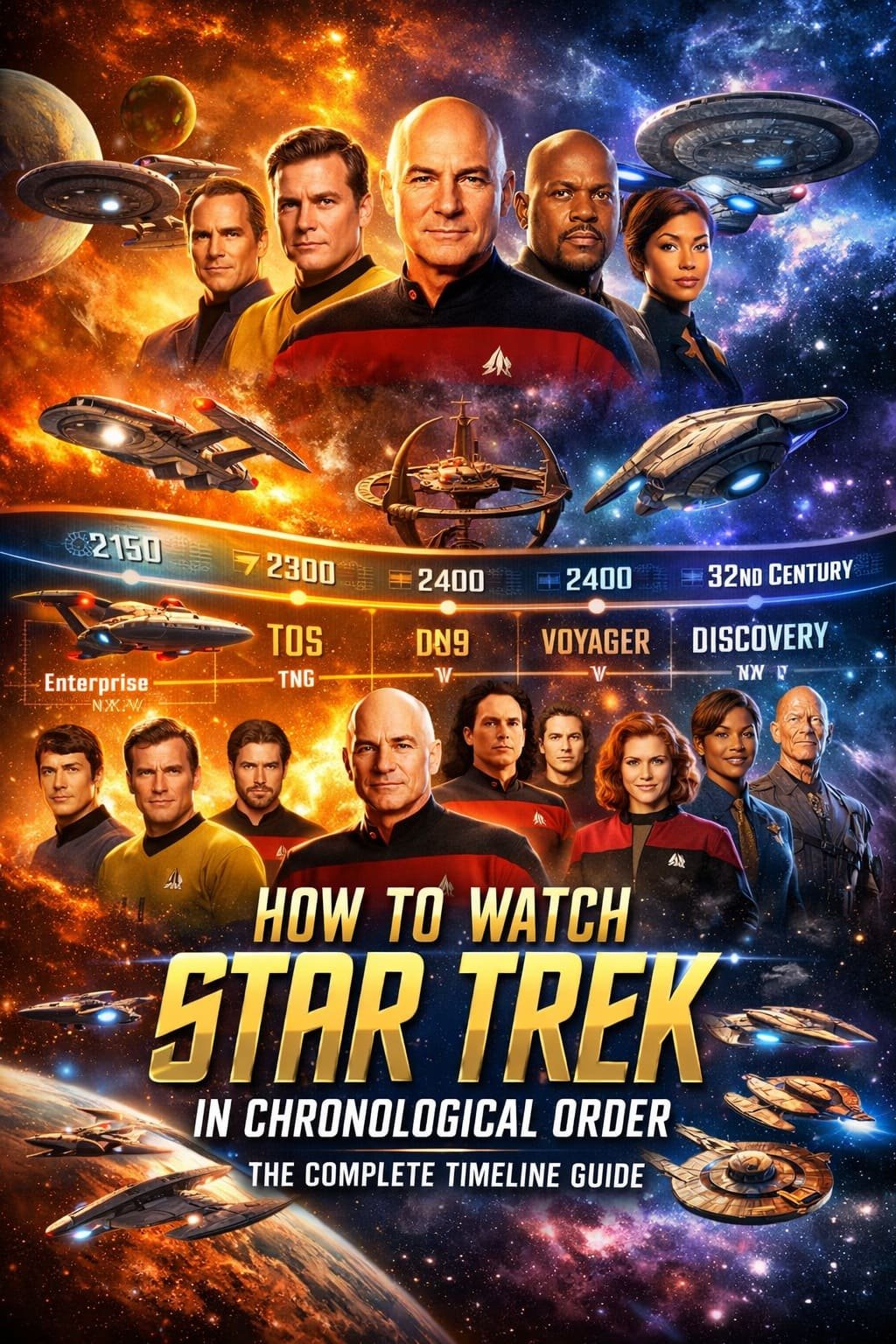
The Star Trek universe spans more than five decades of storytelling, multiple timelines, and numerous starships exploring strange new worlds. With several series and films set across different centuries, watching Star Trek in release order is simple — but following the chronological timeline gives a deeper understanding of the evolution of the Federation, its technology, and its iconic characters.
This guide presents the complete chronological order of Star Trek based on in-universe timelines, helping both newcomers and longtime fans experience the saga as it unfolds in the future history of humanity.
Star Trek stories are primarily set between the 22nd and 32nd centuries, following humanity’s journey from early warp exploration to a vast interstellar alliance known as the United Federation of Planets.
Two major timeline branches exist:
This guide focuses mainly on the Prime Timeline, with the Kelvin films listed separately.
Set before the Federation exists, this prequel follows Captain Jonathan Archer and the NX-01, Earth’s first warp-5 starship.
Why watch: Shows humanity’s first deep-space exploration and early contact with alien civilizations.
This series explores a tense period between the Federation and Klingon Empire.
Why watch: Expands Star Trek lore and introduces advanced technology and political tensions.
Follows Captain Pike aboard the USS Enterprise before Kirk takes command.
Why watch: Classic exploration storytelling with modern production quality.
Captain James T. Kirk leads the USS Enterprise on legendary missions.
Why watch: Introduces iconic characters like Spock and foundational Star Trek ideals.
The original crew returns in six feature films.
Why watch: Expands character arcs and explores Cold War-era diplomacy themes.
Set nearly a century later, Captain Jean-Luc Picard commands the Enterprise-D.
Why watch: Defines modern Star Trek with philosophical storytelling and diplomacy.
A space station near a wormhole becomes the center of political conflict.
Why watch: Darker storytelling and long-form narrative arcs.
USS Voyager is stranded in the Delta Quadrant and must journey home.
Why watch: Survival story with strong character development.
Films featuring the Next Generation crew.
Why watch: Bridges the transition from Kirk’s era to Picard’s.
An animated comedy focusing on support crew members.
Why watch: Humorous take packed with references for longtime fans.
A younger crew discovers a lost Starfleet vessel.
Why watch: Great entry point for younger audiences.
Follows a retired Picard confronting new galactic threats.
Why watch: Emotional continuation of The Next Generation legacy.
The crew travels far into the future.
Why watch: Explores the far future of the Federation.
These movies exist in a separate timeline:
Note: Watch anytime after The Original Series era for context.
If you’re new: Start with Strange New Worlds or The Next Generation before diving into full chronology.
If you want the full experience: Follow the chronological order above to watch humanity’s journey unfold naturally.
If you prefer classic storytelling: Watch The Original Series first, then continue forward.
Watching chronologically allows you to:
Watching Star Trek in chronological order transforms the franchise from separate shows into one continuous epic about exploration, diplomacy, and humanity’s future. From the early warp flights of Enterprise to the distant future explored in Discovery, the journey reveals a hopeful vision of cooperation and discovery that remains as relevant today as when the franchise began.
Whether you are exploring the galaxy for the first time or revisiting it with fresh perspective, this timeline offers the most immersive way to experience one of science fiction’s greatest universes.
Disclaimer: This guide follows the commonly accepted Star Trek timeline. Viewing preferences may vary due to alternate timelines and ongoing releases.
Image Credits: Created by ChatGPT using DALL·E (OpenAI).
To know more about our platform, visit our About Us page.


Comments