Artificial intelligence has moved far beyond simple chatbots and rule-based systems. Today, developers are building applications that can reason, retrieve information, interact with tools, and adapt to complex workflows. This is where LangChain comes into the picture. LangChain is a powerful framework designed to make it easier to build applications powered by large language models (LLMs) in a structured and scalable way.
LangChain is an open-source framework that helps developers connect large language models like GPT with external data sources, APIs, and custom logic. Instead of using an LLM as a standalone text generator, LangChain allows you to build intelligent systems where the model can think step by step, call tools, remember past interactions, and make decisions based on context.
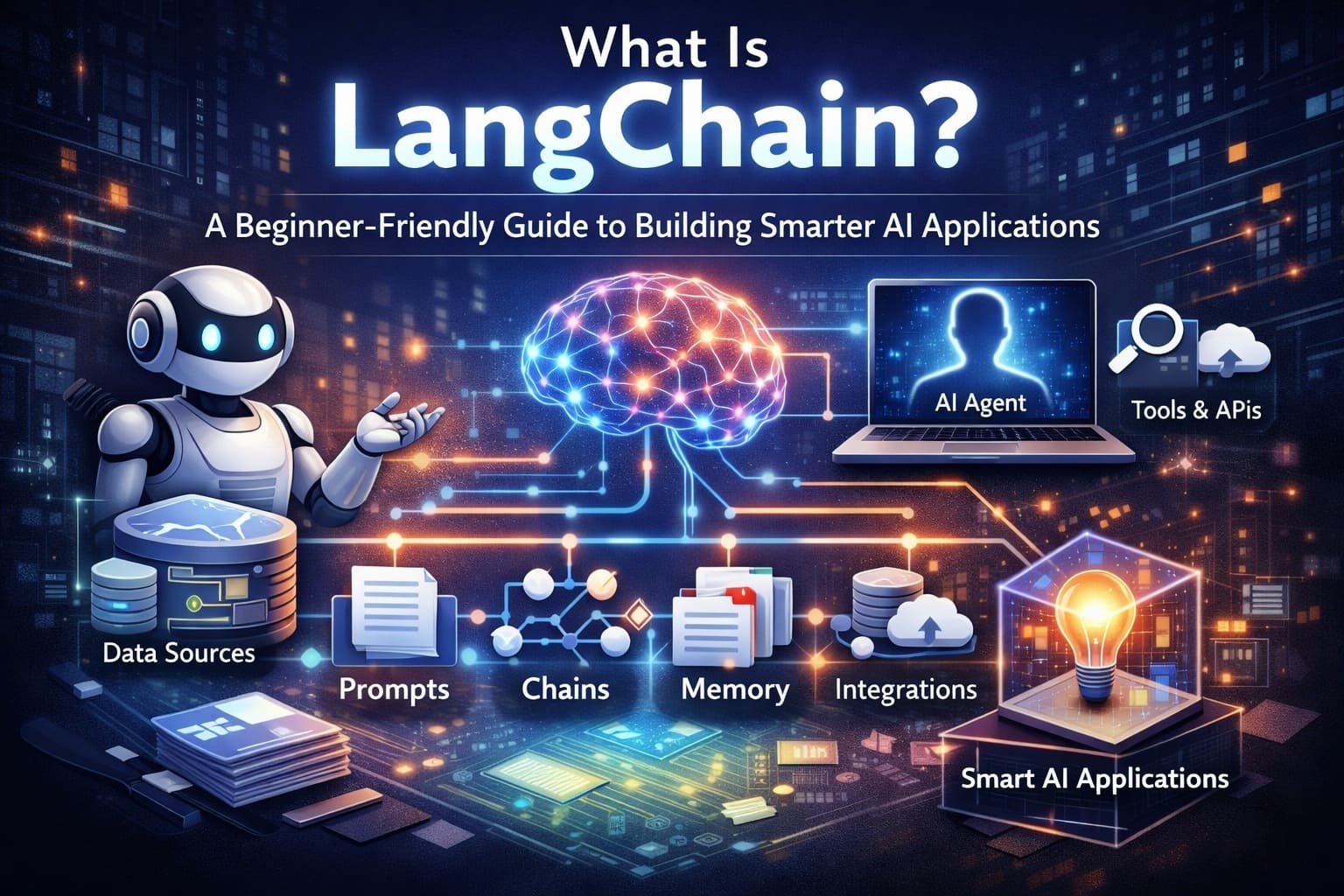
At its core, LangChain focuses on chaining together different components—such as prompts, models, memory, and tools—into a single workflow. This makes AI applications more reliable, flexible, and closer to real-world use cases.
Large language models are incredibly capable, but using them directly has limitations. They don’t naturally remember past conversations, access live data, or follow complex multi-step tasks on their own. LangChain was created to bridge this gap.
By providing a structured way to combine LLMs with logic and external systems, LangChain enables developers to move from simple demos to production-ready AI applications.
Chains are the backbone of LangChain. A chain is a sequence of steps where the output of one step becomes the input for the next. For example, a chain might take a user question, refine it, search a database, and then generate a final answer based on the retrieved data.
Prompts in LangChain are more than plain text. They can be dynamic, reusable, and parameterized. This allows developers to design consistent instructions for the language model while adapting to different inputs and use cases.
Memory allows LangChain applications to remember past interactions. This is especially useful for chatbots, virtual assistants, and customer support systems where context from previous messages improves the quality of responses.
Agents are one of the most powerful features of LangChain. An agent can decide which tool to use based on the user’s query. For example, it might choose to search the web, query a database, or perform a calculation before responding.
LangChain supports integration with APIs, databases, vector stores, and external services. This makes it possible for AI applications to work with real-time data instead of relying only on the model’s training knowledge.
LangChain is widely used across different industries and projects. Some common use cases include:
One of the biggest advantages of LangChain is structure. It helps developers organize AI logic in a clean and maintainable way. It also improves reliability by breaking down complex tasks into smaller, manageable steps.
LangChain is model-agnostic, meaning it works with different language models, not just one provider. This flexibility allows teams to experiment, scale, and adapt as AI technology evolves.
LangChain is ideal for developers, startups, and businesses looking to build advanced AI-driven applications. If you are moving beyond basic text generation and want your AI system to reason, retrieve data, or interact with tools, LangChain provides a strong foundation.
Even for beginners, LangChain can simplify complex AI workflows by offering ready-made components and clear abstractions.
LangChain represents a major step forward in how AI applications are built. Instead of treating large language models as isolated tools, it enables developers to create intelligent systems that think, remember, and act. As AI continues to shape modern software, frameworks like LangChain will play a key role in turning raw model power into practical, real-world solutions.
Q1: What is LangChain used for?
LangChain is used to build AI applications that combine large language models with tools, memory, APIs, and external data for more intelligent and reliable outputs.
Q2: Is LangChain only for chatbots?
No, LangChain is used for chatbots, document-based Q&A systems, AI agents, research assistants, and many other advanced AI workflows.
Q3: Does LangChain work with all language models?
LangChain is model-agnostic and supports multiple LLM providers, allowing developers to switch or experiment without rebuilding the entire application.
Q4: Is LangChain beginner-friendly?
Yes, LangChain offers reusable components and clear abstractions, making it easier for beginners to build complex AI systems step by step.
Q5: Do I need programming knowledge to use LangChain?
Basic programming knowledge, especially in Python or JavaScript, is recommended to effectively build and customize applications using LangChain.
Image Credits: Created by ChatGPT using DALL·E (OpenAI).
To know more about our platform, visit our About Us page.


Comments