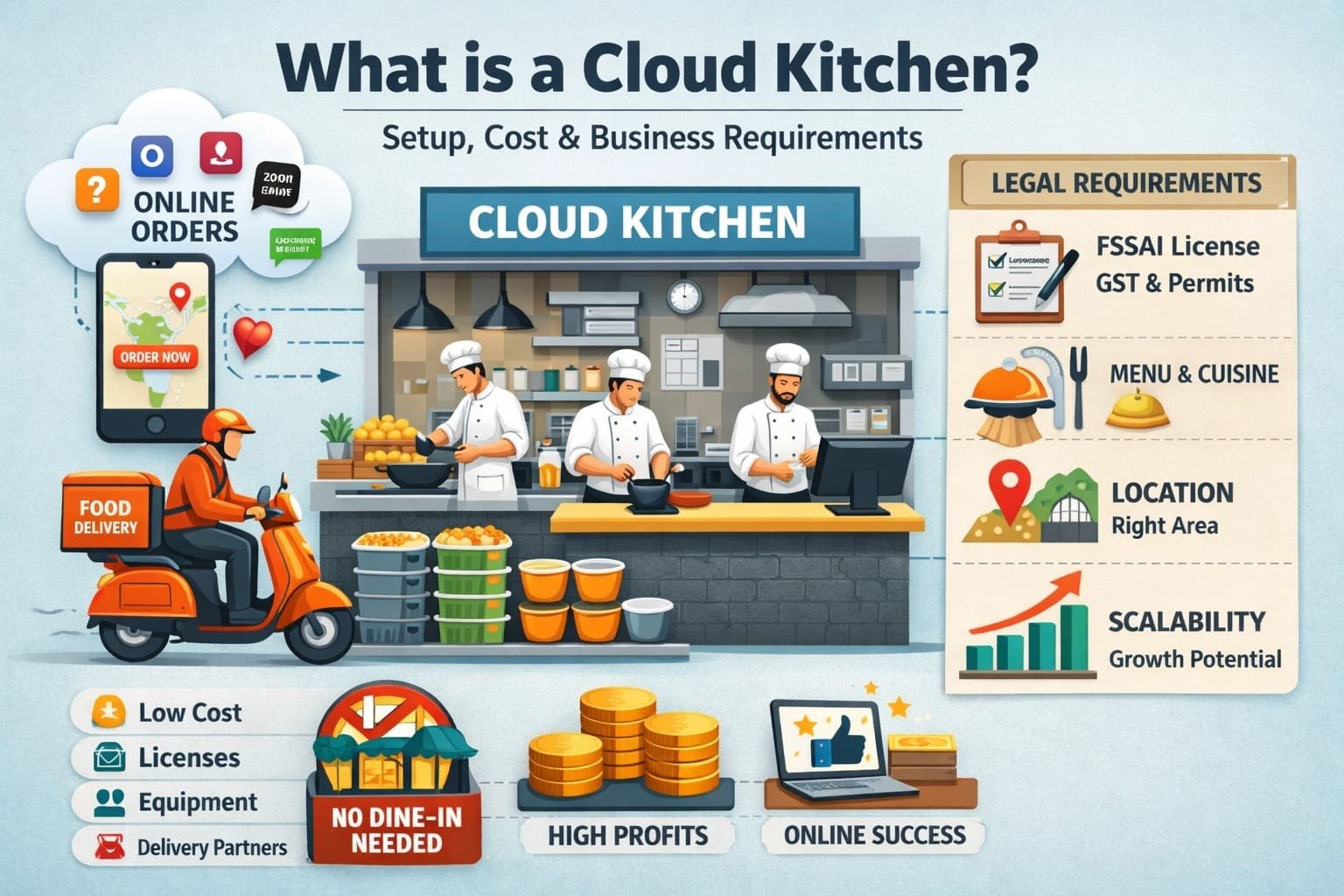
A cloud kitchen, also known as a ghost kitchen or virtual kitchen, is a food business model that operates without a traditional dine-in space. These kitchens prepare food exclusively for delivery through online food ordering platforms like Swiggy, Zomato, Uber Eats, or their own apps and websites. Customers never visit the kitchen; all orders are received digitally and delivered to their doorstep.
This model has grown rapidly due to rising food delivery demand, lower startup costs, and changing consumer preferences. Entrepreneurs, chefs, and restaurant owners are increasingly choosing cloud kitchens as a smarter and more scalable way to enter the food business.
A cloud kitchen is a commercial kitchen space designed only for food preparation and delivery. It eliminates the need for seating areas, décor, wait staff, and front-of-house operations. The focus is entirely on efficient cooking, packaging, and fast delivery.
Cloud kitchens can operate as a single brand, multiple brands from one kitchen, or even as a shared kitchen space where multiple businesses work under one roof.
The workflow of a cloud kitchen is simple and technology-driven. Orders are placed online through food delivery apps or a brand’s own ordering system. The kitchen receives the order, prepares the food, packs it securely, and hands it over to delivery partners. Payments are processed digitally, and customer feedback is collected online.
This streamlined approach helps reduce operational complexity and allows owners to focus on food quality and brand growth.
This model operates one food brand from a single kitchen, focusing on a specific cuisine or menu.
Multiple brands run from the same kitchen, using shared staff and equipment to maximize profits.
Food delivery platforms provide kitchen space and infrastructure, while the brand focuses only on cooking.
Multiple independent businesses rent kitchen space and operate separately within a shared facility.
Without dine-in space, interior design, or service staff, initial investment is significantly reduced.
Lower rent and operational expenses lead to better margins compared to traditional restaurants.
Brands can easily expand to multiple locations or launch new virtual brands using the same kitchen.
Online platforms provide valuable insights into customer behavior, preferences, and demand trends.
Select an area with high delivery demand and good access to residential or office zones. Since customers won’t visit, visibility is less important than delivery reach.
Focus on a niche or popular cuisine that travels well and maintains quality during delivery. Keep the menu concise to reduce waste and complexity.
Invest in essential cooking equipment such as burners, ovens, refrigerators, exhaust systems, and storage units. Ensure the layout supports smooth workflow.
Register the business legally under the appropriate structure such as proprietorship, partnership, or private limited company.
Secure food safety and local compliance licenses before operations begin.
Register your brand on food delivery apps or create your own online ordering system with delivery support.
Food Safety License (FSSAI), GST registration, trade license, and fire safety clearance are commonly required.
Commercial-grade stoves, refrigerators, freezers, prep tables, utensils, and packaging tools are essential.
Order management system, POS software, internet connection, and smartphone or tablet for handling orders.
Chefs, kitchen helpers, and cleaning staff are required. Delivery staff may be managed by aggregators.
Quality packaging that preserves food temperature and hygiene plays a critical role in customer satisfaction and repeat orders.
The cost depends on location, kitchen size, and scale of operations. On average, a basic cloud kitchen setup can start with a modest budget compared to a traditional restaurant. Major expenses include rent, equipment, licenses, raw materials, and marketing.
With low entry barriers, competition is intense, requiring strong branding and consistent food quality.
Commission fees and algorithm changes by aggregators can impact profitability.
Without physical presence, maintaining trust depends entirely on reviews, ratings, and food quality.
Focus on food consistency, optimize delivery time, use data analytics to refine your menu, invest in digital marketing, and prioritize customer feedback. Introducing combo meals and limited-time offers can also boost visibility and sales.
A cloud kitchen is an excellent opportunity for aspiring food entrepreneurs looking for a cost-effective and flexible business model. With the right planning, compliance, and focus on quality, it can be scaled quickly and profitably. While competition and platform dependence are real challenges, a strong brand identity and customer-centric approach can help a cloud kitchen stand out and succeed in the evolving food delivery market.
Q1: What is a cloud kitchen business?
A cloud kitchen is a delivery-only food business that operates without a dine-in space and accepts orders through online food delivery platforms or its own website.
Q2: How much investment is needed to start a cloud kitchen?
The investment depends on location and scale, but a basic cloud kitchen can be started with a much lower budget compared to a traditional restaurant.
Q3: Which licenses are required for a cloud kitchen?
A cloud kitchen typically requires an FSSAI license, GST registration, local trade license, and fire safety clearance as per local regulations.
Q4: Is a cloud kitchen profitable?
Yes, cloud kitchens can be profitable due to low operational costs, flexible menus, and the growing demand for online food delivery.
Q5: Can one kitchen run multiple brands?
Yes, a single cloud kitchen can operate multiple virtual brands using the same infrastructure, helping increase revenue and reduce costs.
Image Credits: Created by ChatGPT using DALL·E (OpenAI).
To know more about our platform, visit our About Us page.


Comments