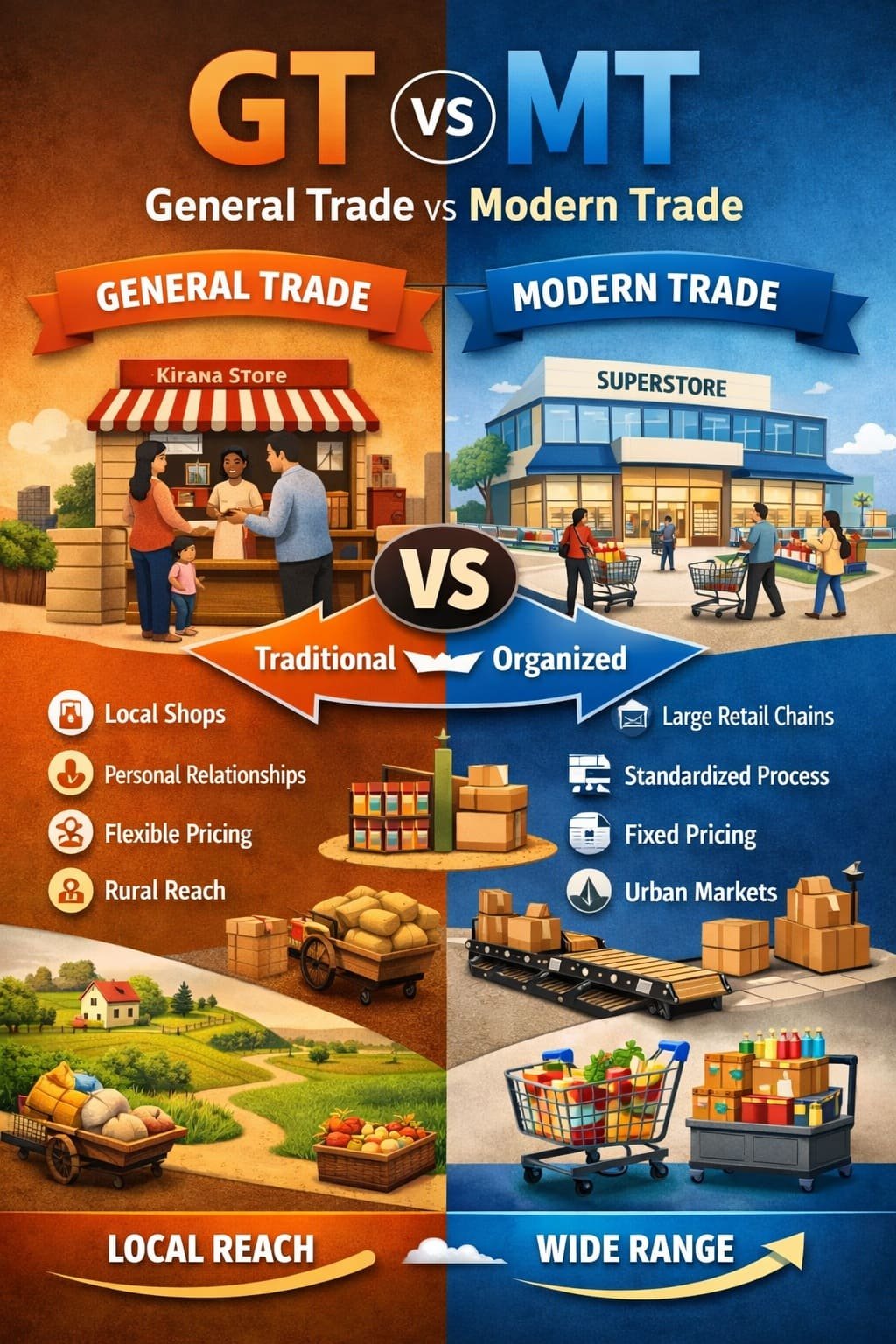
In today’s fast-changing retail landscape, businesses rely on different distribution channels to reach consumers effectively. Two of the most important retail formats are General Trade (GT) and Modern Trade (MT). While both serve the same end goal—selling products to consumers—their structure, operations, and market influence are very different. Understanding the difference between GT and MT is essential for brands, distributors, and marketers aiming to build a strong and sustainable retail strategy.
General Trade refers to traditional, independently owned retail outlets that operate on a small to medium scale. These stores are deeply rooted in local communities and are often family-run businesses.
Typical examples of GT include:
In GT, purchasing decisions are usually made by the shop owner, often based on personal relationships with distributors, credit availability, and local customer demand. This channel plays a crucial role in reaching last-mile consumers, especially in semi-urban and rural areas.
Modern Trade represents organized, large-format retail outlets with standardized operations and centralized decision-making. These stores focus on offering a modern shopping experience with better infrastructure, digital billing systems, and structured supply chains.
Common examples of MT include:
In MT, product listings, pricing, promotions, and shelf space are typically managed at a corporate or regional level rather than by individual store managers.
GT stores are independently owned and operated, while MT outlets are usually part of large retail chains with centralized control.
GT has extensive reach in local neighborhoods and rural areas. MT mainly caters to urban and semi-urban consumers who prefer a modern, one-stop shopping experience.
GT stores carry a limited assortment based on local demand. MT stores offer a wider product range, including premium brands, private labels, and imported goods.
In GT, pricing can be flexible and negotiated. MT follows fixed pricing structures with planned discounts and promotions, often offering lower prices due to higher purchasing power.
GT relies on traditional distributors and personal relationships. MT uses structured supply chains, automated inventory systems, and data-driven forecasting.
In GT, visibility depends on personal influence and retailer relationships. In MT, brands invest heavily in shelf placement, in-store branding, and promotional campaigns.
General Trade remains dominant in many markets due to its unique strengths:
For many FMCG and pharmaceutical brands, GT is still the backbone of volume-driven sales.
Modern Trade offers benefits that appeal to both brands and consumers:
MT is particularly effective for new product launches and premium brand building.
From a brand perspective, GT and MT serve different but complementary roles. GT delivers volume, reach, and steady cash flow, while MT helps with brand image, consumer engagement, and data-driven decision-making.
Companies that rely only on GT may miss out on urban consumers and premium buyers. On the other hand, focusing solely on MT can limit market penetration and increase dependency on fewer, powerful retailers.
A balanced approach allows businesses to maximize both reach and profitability.
There is no single winner between General Trade and Modern Trade. The right choice depends on:
Mass-market products often perform better in GT, while premium, lifestyle, and impulse-driven products gain more traction in MT.
GT and MT are not competitors but complementary pillars of the retail ecosystem. General Trade provides unmatched reach and personal connection, while Modern Trade delivers scale, efficiency, and a modern shopping experience. Brands that understand the strengths of both channels and align their strategies accordingly are better positioned for long-term growth in an increasingly competitive retail environment.
To know more about our platform, visit our About Us page.


Comments